| Dear Colleagues,
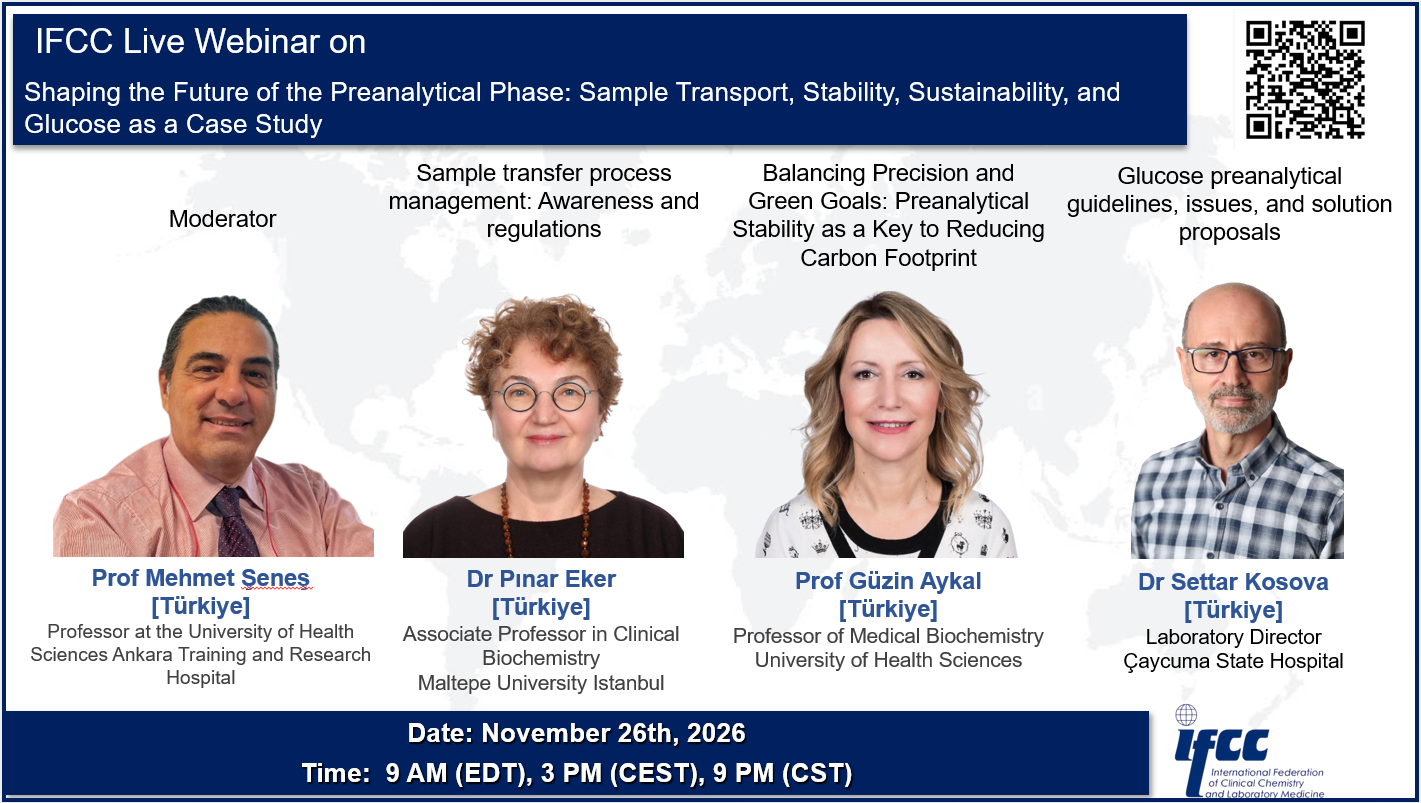
The next IFCC webinar: “Sources of errors in Laboratory Medicine: Shaping the Future of the Preanalytical Phase: Sample Transport, Stability, Sustainability, and Glucose as a Case Study” – will be held on 26th November, 2026.
The preanalytical phase plays a pivotal role in ensuring diagnostic accuracy and patient safety, yet it remains highly vulnerable to errors, particularly those stemming from human factors and sample transport conditions. As laboratory medicine advances, the importance of managing this phase to reduce errors, improve stability, and minimize environmental impact becomes increasingly apparent.
This webinar aims to address these challenges by exploring critical topics in the preanalytical process, including sample transport, stability, and the implementation of sustainable practices in laboratory medicine. The speakers will discuss the delicate balance between precision and sustainability, focusing on how maintaining sample integrity cannot only enhance diagnostic reliability but also reduce the carbon footprint of laboratory practices.
The impact of sample transfer, environmental factors such as temperature fluctuations and mechanical stress, and innovative stabilization methods will be highlighted. Additionally, one speaker will provide an in-depth analysis of the pre-analytical impact on glucose testing, focusing on the role of different blood collection tubes and their effects on glucose stability.
The session will present recent research findings and propose practical improvements to pre-analytical workflows to enhance the reliability of glucose measurements. By providing a comprehensive look at these factors, the webinar will present ways to streamline operations, reduce environmental impact, and promote best practices in the preanalytical phase, ultimately setting a benchmark for sustainable laboratory medicine.
This webinar comprises of three following presentations of 20 min each followed by 20 min of panel discussion at the end.
Chair: Prof. Mehmet Senes
Talk 1: “Sample transfer process management: Awareness and regulations”– Dr. Pinar Eker
Talk 2 “Balancing Precision and Green Goals: Preanalytical Stability as a Key to Reducing Carbon Footprint” – Prof. Güzin Aykal
Talk 3: “Glucose preanalytical guidelines, issues, and solution proposals”- Dr. Settar Kosova
Learning Objectives:
1. Identify current regulatory requirements and evaluatesample transport processes, including pneumatic tube systems in clinicallaboratories.
2. Implement preanalytical stabilitystrategies to reduce repeat testing, optimize laboratory resource utilization,and support environmentally sustainable laboratory practice.
3. Select appropriate glycolysisinhibition strategies to ensure accurate plasma glucose measurement.
Target audience:
- Laboratory specialists and consultants
- Laboratory managers, supervisors, and quality coordinators
- Laboratory technicians and technologists
- Time Zones: Live presentations starting at: 9:00AM EDT-New York ; 3:00PM CSET-Rome; 9:00PM CST-Beijing;
Important: Please ensure that you carefully determine the time that the presentation will start in your global time zone. Click here to convert to your time-zone.
- Recorded webinar: available on demand
- Certificate of participation: available for all registrants
|